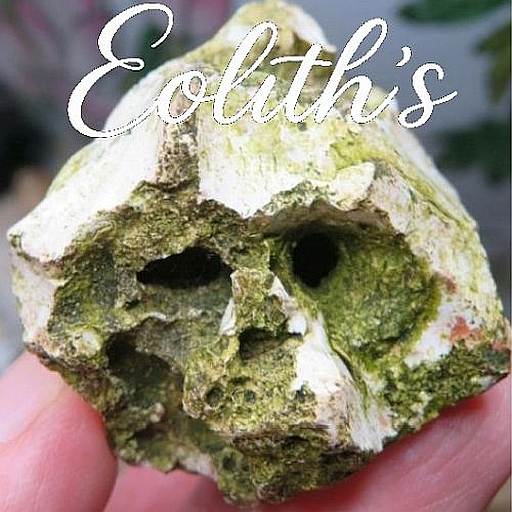
Prehistoric Art, Eoliths & Figure Stones – World’s
Oldest Stone Age Art
Eoliths.org exists because something has gone badly wrong in how
prehistory is described. For over a century, eoliths
and figure stones have been waved away as
“geofacts”, “battered nodules” or “curiosities”, while the obvious prehistoric
art and ancient flint tool technologies
they carry are largely ignored. The earliest researchers in the 19th
century – Boucher de Perthes, Abbott, Rutot, Bourgeois and others –
documented stones with clear profiles of animals and faces, worked
edges and deliberate composition. Instead of engaging with that
evidence, later commentators woefully relabelled these finds as
accidents of nature.
The material presented here tells a very different story. From a
single South Downs site near Boxgrove, and from earlier classic
collections, we see portable rock art, figure
stones and heavily patinated flint tools
that display planning, symmetry and repeated motifs. These are not
random fractures. They are stone age art and ancient
figurative art in flint, created using real toolmaking
skills and a visual language that recurs across pieces, layers and
even regions. All common sense and logic point to sophisticated
tools and figurative artworks from great antiquity, not only
in my finds but in the original 19th-century discoveries that were
quietly written out of the story.
On this site you will find high-patina flint tools, Oldowan- and
Acheulean-style technologies, and some of the strongest candidates
for the world’s oldest art in stone: engraved,
pecked and sculpted pieces that combine cutting edges with images of
animals, faces and composite forms. Multiple lines of evidence –
patina depth, geological context, technological consistency and
cross-comparison of motifs – all support deliberate human agency.
The aim of Eoliths.org is simple: to put that evidence for ancient
stone age art and portable rock art back on the table and
invite serious scientific scrutiny instead of automatic dismissal.
Rethinking Early Human Origins
For over a century, archaeologists and collectors have wrestled
with the question of eoliths “dawn stones” found in Tertiary
deposits and once thought to be the earliest human tools. Many
dismissed them as “geofacts” because they seemed impossibly old, but
the evidence keeps returning: deliberate flake removals, platforms,
bulbs of percussion, design, convention, obvious tools and a patina
depth that speaks of enormous age.
Wikipedia repeats the old 1905 claim that eoliths are now believed
to be simply made by natural fractures, not tools — an idea based on
early bias and limited testing. The example shown there looks crude,
completely unrepresentative of historical eolith collections (even
here they cannot prove a lack of agency). Many real eoliths show
clear signs of shaping, controlled blade edges, and intentional
working, indistinguishable from palaeolithic tool sets. Even the
term “crude” is misleading: some eolith design may be minimal yet
elegant. Showing something that looks crude while ignoring the finer
shaped tools is a failure of observation. The assumption of
randomness is what’s unscientific; the evidence of human agency is
right there in the stone.
Some of these stones are more than just tools. They cross the
boundary into art. Figure stones, first discussed in the 19th
century by Abbé Bourgeois and Jacques Boucher de Perthes, often show
animal profiles, ape faces, or figurative art. To wave them aside as
“accidental” ignores the consistency of whole assemblages where one
piece after another repeats the same motifs, clearly ancient
sculpture.
That is where the question of evidence of cognition becomes
central. If these stones were intentionally shaped, then humans or
pre-human ancestors were sculpting figurative art far earlier than
textbooks allow. We are not looking at a sudden spark of art in the
Upper Palaeolithic, but a much deeper tradition stretching into the
Miocene and Pliocene.
But how do we know how old such finds are? This is where science
can help. Patina, the hydrated rind that slowly builds on flint,
thickens over hundreds of thousands to millions of years. My dating
flint artefact patina chart compiles measurements from global
archaeological literature and shows that some of these artefacts are
consistent with multi-million-year antiquity. Other artefact dating
methods, the geology, typology, and even spectroscopy of pigments,
can add further support, though every approach has limits.
Ultimately, these questions come together in the attempt to date
ancient artefacts and art. Before dating, one must prove agency: is
it truly art, a stone tool or just natural form? Once intent is
established, cross-checking with patina, geological stratigraphy,
and comparison to the fossil record offers provisional timelines.
If you’d rather see the evidence directly, the Revelation in Stone
video series brings many of these pieces to life, showing close-up
studies of flint tools, figure stones, portable rock art and motifs,
alongside historical accounts of the earliest discoveries.
This page introduces eoliths, portable rock
art, figure stones and the wider problem of dating heavily patinated
flint tools from Tertiary contexts.