Prehistoric Art, Eoliths & Figure Stones – World’s Oldest Stone Age Art

Eoliths.org exists because something has gone badly wrong in how prehistory is described. For over a century, eoliths and figure stones have been waved away as “geofacts”, “battered nodules” or “curiosities”, while the obvious prehistoric art and ancient flint tool technologies they carry are largely ignored. The earliest researchers in the 19th century – Boucher de Perthes, Abbott, Rutot, Bourgeois and others – documented stones with clear profiles of animals and faces, worked edges and deliberate composition. Instead of engaging with that evidence, later commentators woefully relabelled these finds as accidents of nature.

The material presented here tells a very different story. From a single South Downs site near Boxgrove, and from earlier classic collections, we see portable rock art, figure stones and heavily patinated flint tools that display planning, symmetry and repeated motifs. These are not random fractures. They are stone age art and ancient figurative art in flint, created using real toolmaking skills and a visual language that recurs across pieces, layers and even regions. All common sense and logic point to sophisticated tools and figurative artworks from great antiquity, not only in my finds but in the original 19th-century discoveries that were quietly written out of the story.

On this site you will find high-patina flint tools, Oldowan- and Acheulean-style technologies, and some of the strongest candidates for the world’s oldest art in stone: engraved, pecked and sculpted pieces that combine cutting edges with images of animals, faces and composite forms. Multiple lines of evidence – patina depth, geological context, technological consistency and cross-comparison of motifs – all support deliberate human agency. The aim of Eoliths.org is simple: to put that evidence for ancient stone age art and portable rock art back on the table and invite serious scientific scrutiny instead of automatic dismissal.

Rethinking Early Human Origins

For over a century, archaeologists and collectors have wrestled with the question of eoliths “dawn stones” found in Tertiary deposits and once thought to be the earliest human tools. Many dismissed them as “geofacts” because they seemed impossibly old, but the evidence keeps returning: deliberate flake removals, platforms, bulbs of percussion, design, convention, obvious tools and a patina depth that speaks of enormous age.

Wikipedia repeats the old 1905 claim that eoliths are now believed to be simply made by natural fractures, not tools — an idea based on early bias and limited testing. The example shown there looks crude, completely unrepresentative of historical eolith collections (even here they cannot prove a lack of agency). Many real eoliths show clear signs of shaping, controlled blade edges, and intentional working, indistinguishable from palaeolithic tool sets. Even the term “crude” is misleading: some eolith design may be minimal yet elegant. Showing something that looks crude while ignoring the finer shaped tools is a failure of observation. The assumption of randomness is what’s unscientific; the evidence of human agency is right there in the stone.

Some of these stones are more than just tools. They cross the boundary into art. Figure stones, first discussed in the 19th century by Abbé Bourgeois and Jacques Boucher de Perthes, often show animal profiles, ape faces, or figurative art. To wave them aside as “accidental” ignores the consistency of whole assemblages where one piece after another repeats the same motifs, clearly ancient sculpture.

That is where the question of evidence of cognition becomes central. If these stones were intentionally shaped, then humans or pre-human ancestors were sculpting figurative art far earlier than textbooks allow. We are not looking at a sudden spark of art in the Upper Palaeolithic, but a much deeper tradition stretching into the Miocene and Pliocene.

But how do we know how old such finds are? This is where science can help. Patina, the hydrated rind that slowly builds on flint, thickens over hundreds of thousands to millions of years. My dating flint artefact patina chart compiles measurements from global archaeological literature and shows that some of these artefacts are consistent with multi-million-year antiquity. Other artefact dating methods, the geology, typology, and even spectroscopy of pigments, can add further support, though every approach has limits.

Ultimately, these questions come together in the attempt to date ancient artefacts and art. Before dating, one must prove agency: is it truly art, a stone tool or just natural form? Once intent is established, cross-checking with patina, geological stratigraphy, and comparison to the fossil record offers provisional timelines.

If you’d rather see the evidence directly, the Revelation in Stone video series brings many of these pieces to life, showing close-up studies of flint tools, figure stones, portable rock art and motifs, alongside historical accounts of the earliest discoveries.

This page introduces eoliths, portable rock art, figure stones and the wider problem of dating heavily patinated flint tools from Tertiary contexts.
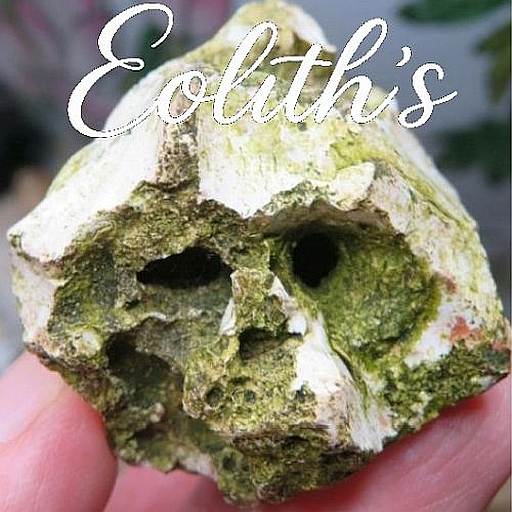
Heavily patinated eoliths and figure stones from the South Downs assemblage
Representative eoliths and figure stones from the South Downs assemblage. Thick patina, repeated motifs and edge-working suggest deliberate making and extreme antiquity.
eolith prehistoric artwork
A stunning worked flint sculpture find from the South Downs assemblage. Repeated motifs, careful flake removal and symmetry, evidence of design, cognition and agency.  A thick white patina suggests extreme antiquity.

Explore the Foundations of Eolith Research

What are eoliths?

Eoliths are ancient stone artifacts from Tertiary layers, once dismissed as natural breaks. FAQ-style resources explain their features, why they matter, and how they’re defined in archaeology.

Eoliths: Ancient Flint Tools from Tertiary Layers

What are figure stones?

Figure stones are rocks shaped or selected to resemble animals, faces, or symbolic forms. Learn definitions, examples, and how to tell them apart from naturally broken pieces.

Figure Stones: Portable Rock Art & Prehistoric Faces

What is Portable Rock Art?

Portable rock art refers to carvings, engravings, and modified stones small enough to carry. Our hub explains its definition, examples worldwide, and why it’s controversial.

Portable Rock Art: Ancient Carvings & Symbolic Stones

Prove it's Worked

How to recognize artifactuality in stone finds. Patterns of shaping, symmetry, and repeated imagery in flint suggest early symbolic behaviour. This hub explains ways to identify artifacts as being made and not as random products of nature.

Eoliths and Evidence of Cognition.

Dating Artifact Techniques

Artifacts can be studied using patina depth, stratigraphy, typology, and advanced methods like luminescence or radiocarbon. This hub summarizes dating options and limitations.

How old is my Portable Rock Art?

Revelation in Stone (Video Series)

Clearly superior tools and ancient art assemblage, literally nothing out there compares. In this video-led introduction to eoliths, figure stones, and portable art. Episodes combine finds, methods, and context to make the science accessible.

Eoliths Videos

Revelation in Stone

Eoliths: The Dawn of Human Art and Tools Revelation in Stone is a journey into the world of eoliths—ancient flint artefacts that redefine our understanding of human history, cognition, and creativity. Through my groundbreaking discoveries, we’ll explore the artistry and ingenuity of our prehistoric ancestors and uncover a story that challenges conventional archaeology.

The Story Behind Eoliths

Eoliths are far more than mere products of nature. These flint artefacts exhibit intentional craftsmanship, symmetry, and figurative artistry—proof of deliberate human action. Unearthed in Southern England and across the globe, these artefacts highlight a worldwide phenomenon of early human creativity. They demand we rethink established theories about the origins of art, language, and human evolution.

Key Highlights

About the Discovery

Through remarkable flint tool and art assemblages from Southern England, I have uncovered artefacts that are more than tools—they are works of art. Similar discoveries in India, Indonesia, and Europe reveal a global pattern of intentional design and creativity.

What Makes These Artefacts Extraordinary

A Lifetime of Discovery

I've been finding and collecting fossils and flint tools since I was a child. In 2011, I discovered a flint tool with images of an elephant and a horse, and I immediately realized its significance. Elephants roamed the local area at least 100,000 years ago, making this one of the oldest pieces of ancient prehistoric art ever found.

Unveiling Prehistoric Art

As an independent researcher in the fields of lithics and Palaeolithic figurative art and stone tools, I have numerous published papers and articles in respected archaeological journals. Over the past 12 years, I've taught people about this discovery and its implications. As the original decoder of this ancient worldwide art form, I provide a unique window into prehistoric times, the science behind the finds, how to recognize and validate such discoveries, and detailed information on these incredible works of figurative art. Although other notable researchers in the past found faces and motifs in stone finds, the clarity of my stone tools finds, and the application of a true scientific method, comparing certain figures from around the world was key to unlocking a secret from our distant past.

Join the Discovery

Eoliths are the key to unlocking humanity’s earliest chapters. Whether you’re a researcher, student, or simply curious about our origins, there’s something here for everyone. Let’s explore the dawn of human art and tools together.

Audience

My audience is international, spanning Europe, America, and beyond, one of my biggest fans from Canada, has since opened his own successful stone art website. Whether you’re an archaeologist, a historian, or someone passionate about the mysteries of the past, Revelation in Stone offers unique insights into our shared human story.

Let’s Connect for More

Thank you for visiting Revelation in Stone. Together, we’ll delve into the artefacts, theories, and implications of this groundbreaking discovery. The dawn of human creativity awaits—let’s uncover it!

Connect Now